If B2B payment fraud is now a core cyber resilience risk, why are organizations still failing to stop it?
This is the challenge organizations are now facing. It reflects a broader shift in how cyber risk is being defined, with implications that aren’t theoretical but show up in real financial outcomes.
To answer that very question, Trustmi analyzed real-world attacks in The Payment Security & Risk Benchmark Report 2026, focusing on how modern fraud is constructed and how it moves through enterprise workflows.
What that analysis reveals is a gap between how current cyber resilience controls are designed, and how B2B payment fraud actually works.
Malicious Signals vs. Trusted Signals
In the report, Trustmi analyzed real-world B2B payment fraud attacks and found a consistent pattern: attacks are constructed to arrive effectively pre-approved.
What that means is that attacks are built with an understanding of how controls work. Bad actors consider what gets flagged, blocked, and what gets through. And malicious links, suspicious domains, anomalous behavior—these are the signals most defenses are designed to detect.
So modern fraud avoids those malicious signals.
Instead of introducing something suspicious, attackers replicate what already looks legitimate: real identities, existing communication threads, expected workflows, and familiar documentation. The goal is not to evade controls, but to satisfy them.

A Real-Life Example
There’s a great example of this in the report. It’s a visual deep dive into a real-life vendor impersonation. In the attack, the bad actor gained access to a real vendor email account and inserted themselves into an existing thread. There was no phishing domain, no payload, and no anomalous infrastructure. The attacker followed the conversation, matched its tone and timing, and introduced a request consistent with what the recipient expected to see.
From a detection standpoint, there is no clear signal to flag.
- The sender is legitimate.
- The thread is legitimate.
- The request aligns with prior business context.
Each element of the interaction appears legitimate when evaluated on its own. The sender is known, the communication is consistent, and the request fits within an established business context. By the time the request reaches review, it has already passed through multiple layers of validation.
This is reflected at scale. In 85% of cases, these attacks begin in email and go undetected—not because controls fail, but because the activity does not meet the conditions those controls are designed to identify as malicious.

Point-in-Time vs. Over Time
Another issue with security controls and tools is that most are designed to evaluate risk at a specific moment. An email is scanned when it arrives, and a login is reviewed when it is submitted. Each decision is made based on what is visible at that point in time.
The data in this report shows that modern B2B payment fraud does not operate within those time constraints.
Across incidents, attacks unfold over time. Attackers gain access, establish presence, and then wait. They observe communication patterns, follow active threads, and allow their activity to blend into normal business operations before taking action.
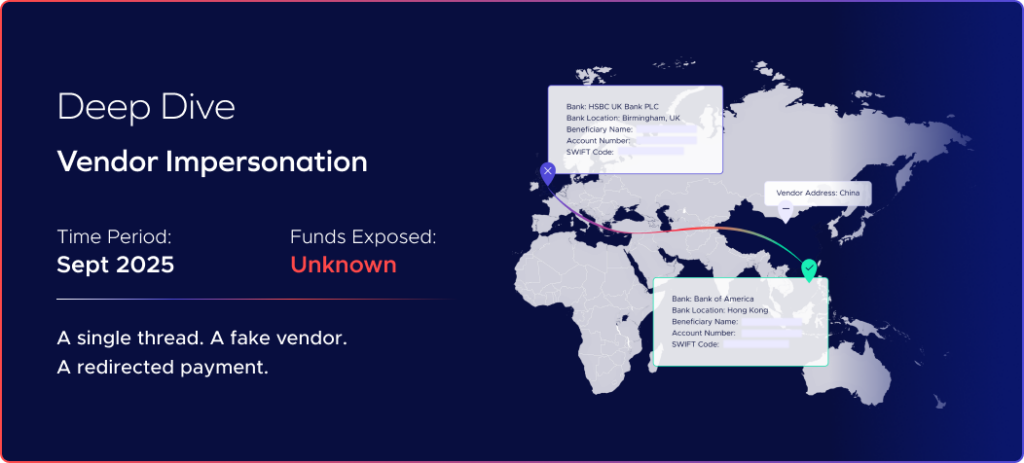
In the deep dive of the vendor impersonation, this is exactly what happened. The attacker did not act immediately after gaining access to a vendor’s email account. They remained in the environment, participating passively in ongoing communication until the right moment to intervene. By the time they introduced a fraudulent request, it was inserted into a thread and context that had already been established as legitimate.
This has an important implication for detection.
There is no early signal that persists. If anything appears slightly unusual at the beginning, it is diluted over time as the activity continues without issue. By the time the request is made, the interaction no longer appears new or suspicious—it appears familiar.

Isolation vs. Connection
The limitation is not just when controls evaluate risk, but where they evaluate it.
Security controls are designed to operate within system boundaries. Email security analyzes messages, identity systems validate access, and finance systems review invoices and approvals. Each control evaluates its own set of signals, within its own context.
The problem is that fraud does not stay within those boundaries.
According to the report, 59% of attacks combine multiple coordinated tactics, including impersonation, fake financial documents, and manipulated communication threads. These elements are not independent. They are designed to reinforce one another across systems, creating a consistent and believable narrative.
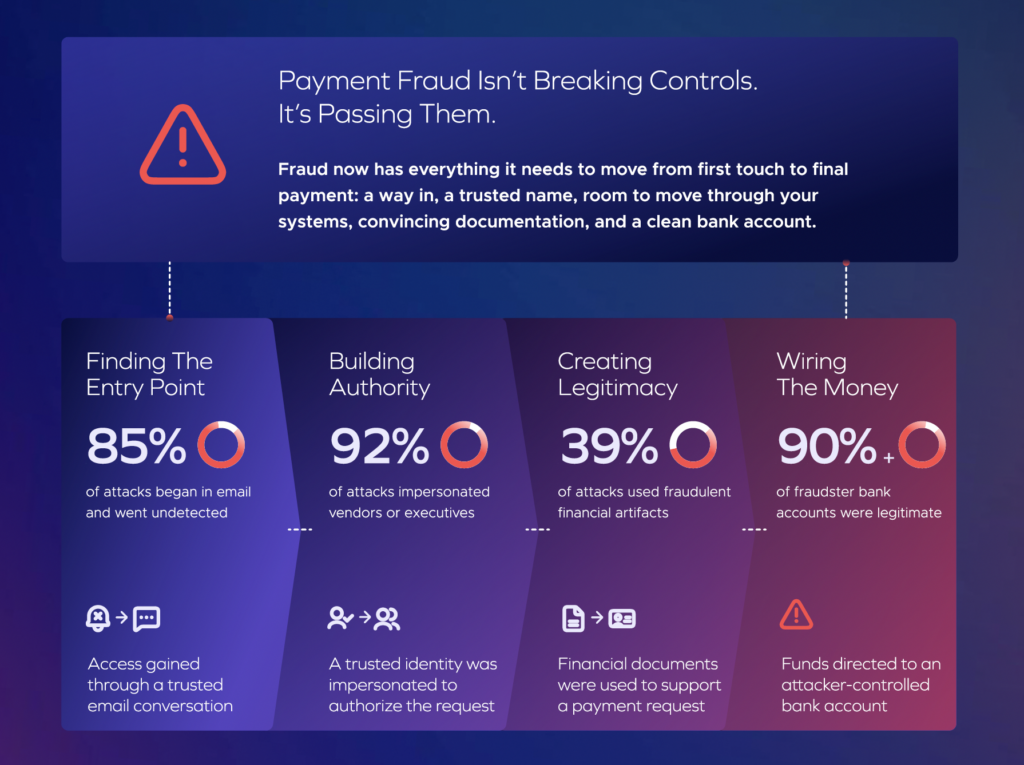
Fraud moves step-by-step across systems. It often enters through email, establishes authority through identity, reinforces legitimacy with documentation, and ultimately directs payment. Each stage builds on the last, making the request appear routine by the time it reaches final approval.
Viewed within any single system, each step appears valid. The signals satisfy the criteria that control is built to evaluate, and there is no clear reason to flag the activity.
What is needed to catch fraud isn’t something in one system, but something that holistically connects all the signals of an attack.

Cyber Resilience Is a Context Problem
And even then, the challenge isn’t just visibility. It’s perspective and context.
Most controls are designed to evaluate individual signals, whether something looks suspicious, whether a request meets a defined set of checks. But modern B2B payment fraud is constructed to pass those checks. It aligns with expectations, fits within workflows, and arrives with the context needed to move forward.
That requires a different way of thinking about risk.
Organizations need to move from asking:
“Did we detect something suspicious?”
to asking:
“Do we understand the full context of this request?”
This is where cyber resilience must evolve. Not as a function of detecting more signals, but as the ability to interpret them together across time, systems, and workflows before a decision is made. To see just how modern fraud slips through security tools and controls, download the full report.
You can also join us on April 14th for a live webinar where we walk through the modern fraud playbook and what it means for security and finance teams.











 Behavioral AI-powered security
 Protection on day one
 10-15x ROI

