


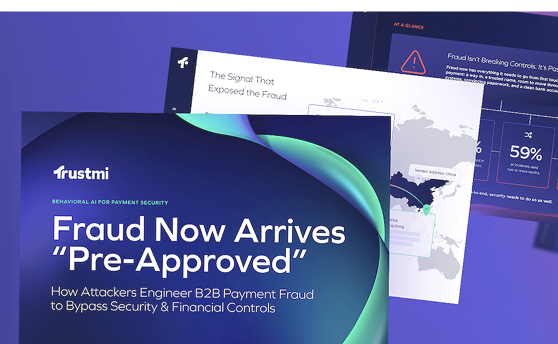

Cyber Fraud That Doesn’t Look Malicious
The Trustmi Payment Security & Risk Benchmark Report 2026
of payment fraud starts in email—and goes undetected
As cyber attacks become more complete and convincing, socially engineered fraud is projected to exceed $40 billion annually by 2027.
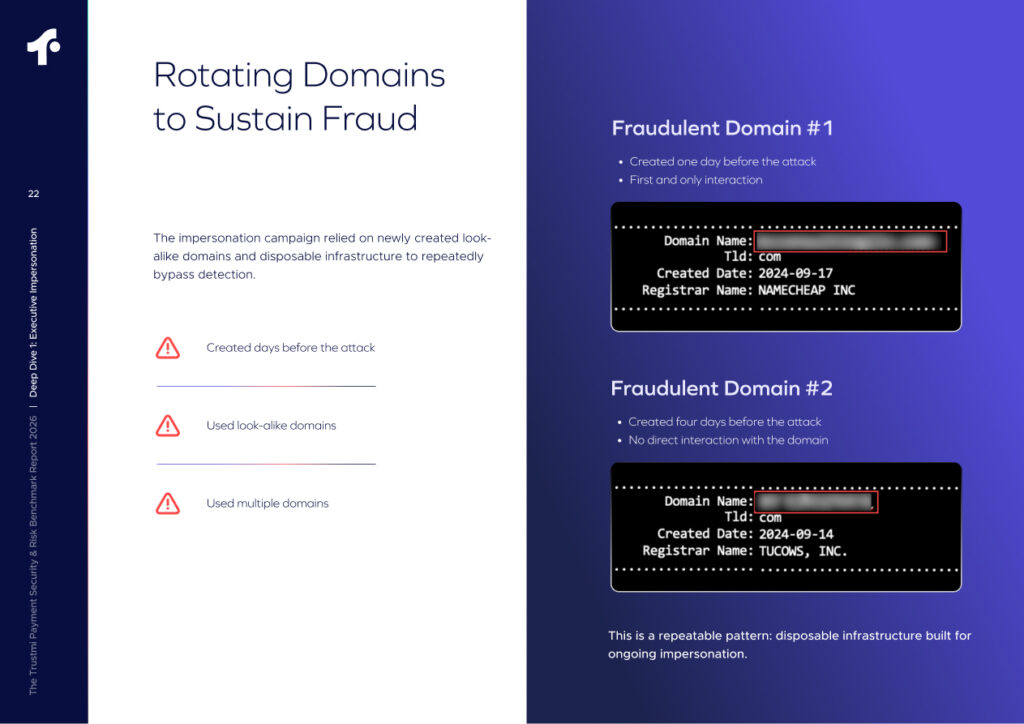
Generative AI is accelerating this shift—enabling attackers to produce convincing emails, lookalike domains, fabricated threads, and vendor communications at scale without triggering traditional cyber defenses.
Based on 260 real-world B2B payment fraud incidents, this report reveals how attackers engineer payment requests to pass cyber controls by appearing legitimate from the start.
When Security Controls Break Down
Modern payment fraud is not a traditional attack. It is social engineering that moves through systems.
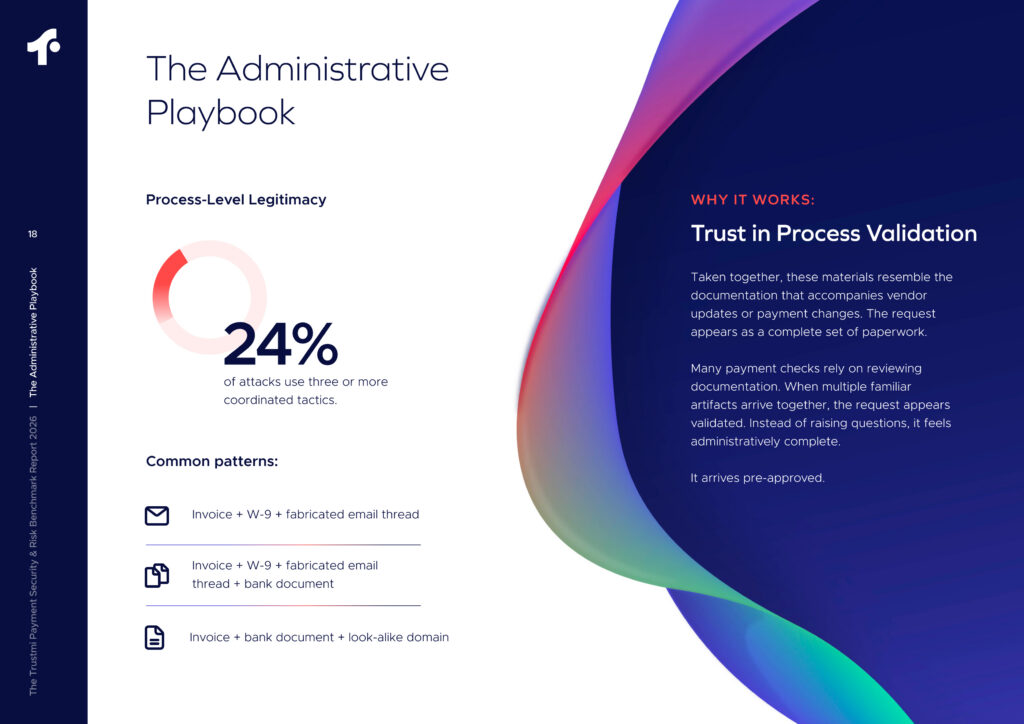
It starts with a trusted identity. 92% of attacks impersonate vendors or executives using real accounts and familiar context.
The attack is reinforced across layers. Invoices, W-9s, and bank details make the request appear legitimate.
Then comes validation, and 90% of fraudster-controlled accounts are valid and in good standing with the bank.
Each control evaluates its layer, but no security control evaluates end-to-end context.
You’ll learn:
- The 3 fraud playbooks behind attacks that look legitimate from the start
- Why fraud slips between security and finance systems even when controls work
- What security leaders must change to reduce risk without slowing down operations









Trusted by Finance and Security Leaders





“Trustmi provided transparency into our payment process to see where cyberattacks and errors were happening and full protection without changing our workflow."

“Like many businesses today, we’ve experienced cyber attacks on our payment process, but we didn’t realize the extent to which we were at risk until we evaluated Trustmi. Now we’re confident we’ll be able to avoid future attacks with their platform.”

“Trustmi’s platform is an important tool for our team. Their Payment Flows module increases our payment cycle security, and our team has also managed to cut down the time for preparing payments reports from half a day to half an hour.”

“Trustmi provided transparency into our payment process to see where cyberattacks and errors were happening and full protection without changing our workflow."
“Like many businesses today, we’ve experienced cyber attacks on our payment process, but we didn’t realize the extent to which we were at risk until we evaluated Trustmi. Now we’re confident we’ll be able to avoid future attacks with their platform.”
“Trustmi’s platform is an important tool for our team. Their Payment Flows module increases our payment cycle security, and our team has also managed to cut down the time for preparing payments reports from half a day to half an hour.”
$240 Billion Secured
Protecting businesses globally against socially engineered fraud and errors.
Up to 2.5% of Budget Saved
By Eliminating Fraud and Payment Errors
From Hours to Seconds
Manual Process Time Reduced
 Behavioral AI-powered security
  Protection on day one
  10-15x ROI