




Payment Flows that Catch Costly Errors
Behavioral AI that extends into the payment run itself, giving Finance, Treasury, and AP one view across every system, and catching the duplicates and errors hiding between them.








Clean Approvals, Expensive Mistakes
The procure-to-pay process catches a lot, but not everything. At enterprise volume, that adds up fast.
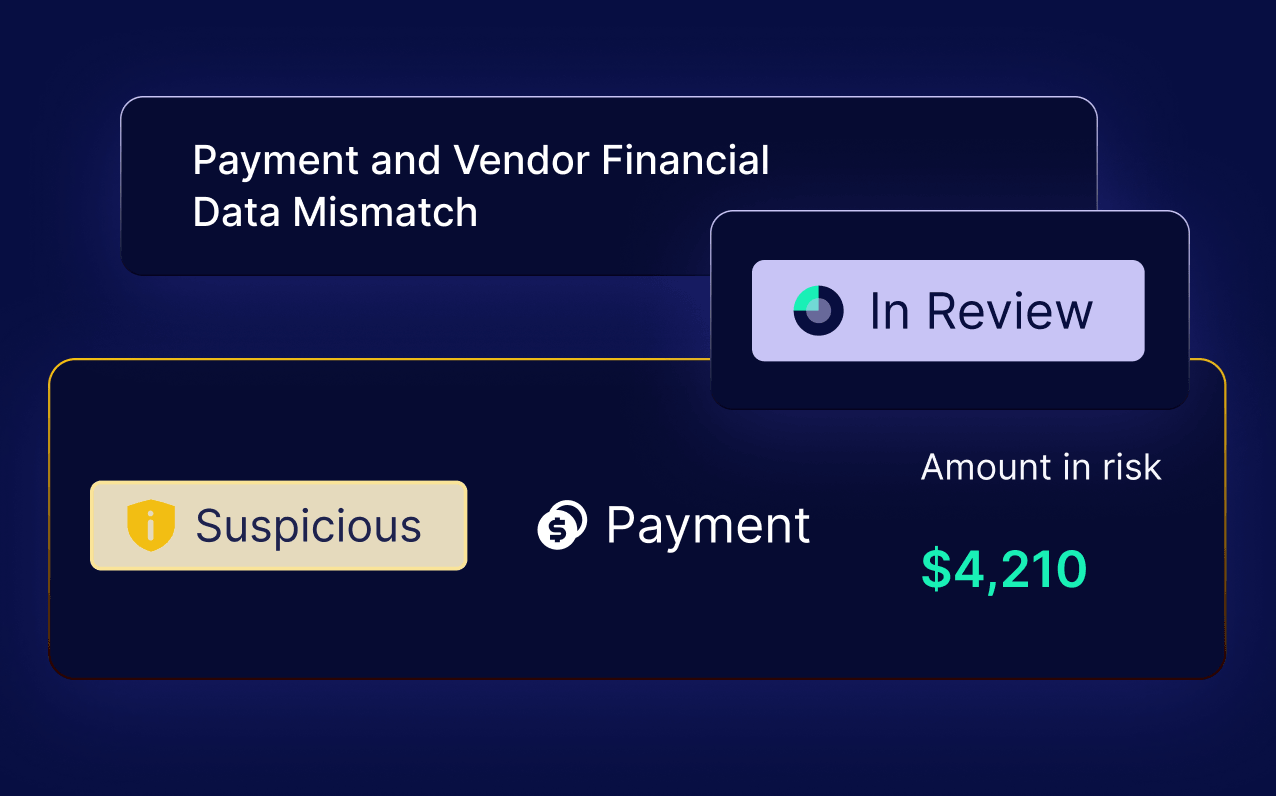
The errors that get through sit between systems and teams. A duplicate paid by two business units, an amount that only looks wrong against the vendor’s history, an approval nobody questioned because each team saw only its step.
Automating the run won’t find them. Catching errors takes context that spans every system and team the payment touches.
AI Catches What Procure-to-Pay Can't
Automated Duplicate Invoice Detection

Cross-Entity Duplicate Payment Detection

One Unified View

A Verdict on Every Payment
For Finance leaders, this means faster close cycles, fewer payment reversals, and a documented control record for audit and compliance.

Meet the AP Diligence Agent
This AI agent turns payment run review from hours of manual checking into minutes. It ingests the batch, scores every payment, clears what’s safe, and routes the exceptions with full context on what it flagged and why. Ask it questions in plain language, and it’ll produce the payment run report on demand.

Errors Caught, Hours Returned
$5B Errors Prevented
Trustmi caught $5B in payment errors across its customers.
20x+ ROI
By eliminating human errors and duplicate payments alone.
6 Hours to Minutes
Payment run validation that took a morning now finishes in minutes.
"Trustmi helps prevent duplicate payments before they're made."
Built on Trustmi Payment Security


FAQs
Payment Security and Payment Flows solve two halves of the same problem. Payment Security stops socially engineered fraud as it moves from email to ERP to payment. Payment Flows takes the same Behavioral AI engine and applies it to the payment run itself, catching duplicates, mismatched amounts, currency errors, and invoices that don’t match the PO. Payment Flows is a premium module that extends Payment Security, so teams running large or complex payment cycles get both fraud detection and payment run controls from one platform.
ERP controls miss duplicates because they match on exact fields. If the same invoice arrives with a slightly different invoice number, a rounded amount, or a different date format, the rule doesn’t fire. Trustmi correlates across attributes instead of matching them, so a duplicate gets caught even when nothing about it matches exactly.
Many enterprises pay from several ERPs at once, often because they grew through acquisition and never consolidated. The same invoice can enter two of those systems under different numbers and get paid twice, once by each business unit, with neither system able to see the other. Trustmi pulls invoice and payment data from every connected system into a single view, recognizing vendors listed under slightly different names or subsidiaries as one vendor. That’s what makes a second copy of an already-paid invoice visible.
Payment Flows records every control it applies, automatically. Each payment carries the checks that ran against it, the verdict, and the evidence behind that verdict, so the control record for SOX testing, internal audit, and external review is generated as a byproduct of the payment run rather than assembled after the fact.
Payment Flows shortens the payment run for most teams. Every payment gets scored automatically, low-risk transactions clear without human review, and only exceptions get routed to a person, with the context needed to resolve them. Teams that spent hours validating a run manually finish in minutes, because the review moves from every line to the handful that actually need attention.
Post-payment recovery audits analyze financial records months after disbursement to identify overpayments, forcing finance teams to chase vendors or claw back funds. Pre-payment duplicate invoice detection acts at the moment of payment run review, catching duplicate invoices, mismatched amounts, and operational errors before funds leave your account, so there’s far less left for a recovery audit to find.
Trustmi applies pre-payment controls across four areas: duplicate invoice detection, cross-entity duplicate payments made from separate ERPs or subsidiaries, mismatched amounts and currency discrepancies that cause overpayments, and invoices that don’t match the purchase order. Because it correlates vendor records and payment history across every connected system, a payment that looks correct in one ERP still gets checked against everything else.
Trusted by Finance and Security Leaders






“Trustmi provided transparency into our payment process to see where cyberattacks and errors were happening and full protection without changing our workflow."

“Like many businesses today, we’ve experienced cyber attacks on our payment process, but we didn’t realize the extent to which we were at risk until we evaluated Trustmi. Now we’re confident we’ll be able to avoid future attacks with their platform.”

“Trustmi’s platform is an important tool for our team. Their Payment Flows module increases our payment cycle security, and our team has also managed to cut down the time for preparing payments reports from half a day to half an hour.”

“Trustmi provided transparency into our payment process to see where cyberattacks and errors were happening and full protection without changing our workflow."
“Like many businesses today, we’ve experienced cyber attacks on our payment process, but we didn’t realize the extent to which we were at risk until we evaluated Trustmi. Now we’re confident we’ll be able to avoid future attacks with their platform.”
“Trustmi’s platform is an important tool for our team. Their Payment Flows module increases our payment cycle security, and our team has also managed to cut down the time for preparing payments reports from half a day to half an hour.”
$240 Billion Secured
Protecting businesses globally against socially engineered fraud and errors.
Up to 2.5% of Budget Saved
By Eliminating Fraud and Payment Errors
From Hours to Seconds
Manual Process Time Reduced
 Behavioral AI-powered security
  Protection on day one
  10-15x ROI