




Fake Invoices Built to Pass Financial Review
Behavioral AI that reads every financial document against the payment behind it, so fraudulent paperwork doesn't clear approval just because it looks right.








Fraud Arrives as Ordinary Paperwork
The most dangerous document your finance team sees this year looks like the most routine one. Fraudulent invoices, W-9s, bank letters, and email threads now arrive together as a packet, each one making the others look verified.
That’s the shift. Attackers no longer submit paperwork to get around your controls. They submit paperwork to satisfy them.
Reading the documents more carefully can’t close this gap. Each one has to be read against the payment behind it.
Why Fake Invoices Get Paid

What It Takes to Catch Fraudulent Paperwork

Read the Metadata

Learn How Each Vendor Bills

Correlate Before You Approve
How Trustmi Stops Fraud Hidden in Financial Documents
Documents Checked Against the Vendor

Every Invoice Inspected

Paperwork Checked Against Behavior

Proven Across the Trustmi Platform
$1B+ Fraud Prevented
Prevention, not reimbursement.
$240B+ Protected
Trusted at enterprise volume.
90% Less Manual Review
Fewer alerts, faster approvals.
This is the old spray-and-pray, rebuilt with AI: a fake invoice, a matching W-9, and a fabricated thread showing a CEO approval that never happened.

Additional Resources

FAQs
Fraudulent invoices are payment requests built to pass your review, not sneak past it. What makes one work isn’t a forged detail. It’s that everything checks out.
Attackers use them because your controls are looking for inconsistency. A fake invoice that matches a PO, carries the right template, and arrives with a W-9 gives those controls exactly what they’re built to confirm. Some bill for work nobody did, some are real invoices with the bank details changed, but they succeed the same way: by arriving complete.
Fake invoices don’t always show up alone. More and more, our research shows they come with fake W-9s, fake bank letters, and email threads that make the whole thing look settled. In our H1 2026 analysis, 1 in 6 incidents paired a fake invoice with a fake W-9, usually to change the bank details on a vendor you already pay.
The invoice asks for the money. Everything else is there to make the ask look legitimate.
Before the payment goes out, and by reading the invoice against the vendor rather than the record. A purchase order match confirms the numbers agree. It can’t confirm the vendor sent the invoice or that the account belongs to them.
No single check settles it. A first-seen bank account only looks wrong next to two years of payments to a different one, so the signals have to be read together rather than one system at a time.
Automated invoice fraud prevention uses machine learning and behavioral AI to watch payment workflows and check incoming invoices without someone reviewing each one by hand. The point isn’t to approve payments automatically. It’s to narrow what reaches an approver, so the requests that need a human get one and the rest keep moving.
SEGs look for bad content: known malicious attachments, blacklisted links, untrusted IP addresses. A fake invoice scam often has none of that. It arrives as clean text from a hijacked vendor account or a convincing look-alike domain, so there’s nothing for the filter to catch.
The bigger gap is context. A SEG scores the message but can’t see the payment it sets up, so a request that reads fine and makes no financial sense goes straight through.
Trustmi reads every document against the payment behind it. Behavioral AI learns how each vendor bills you, how often, through which approvers, and into which account, then scores each new request against that history.
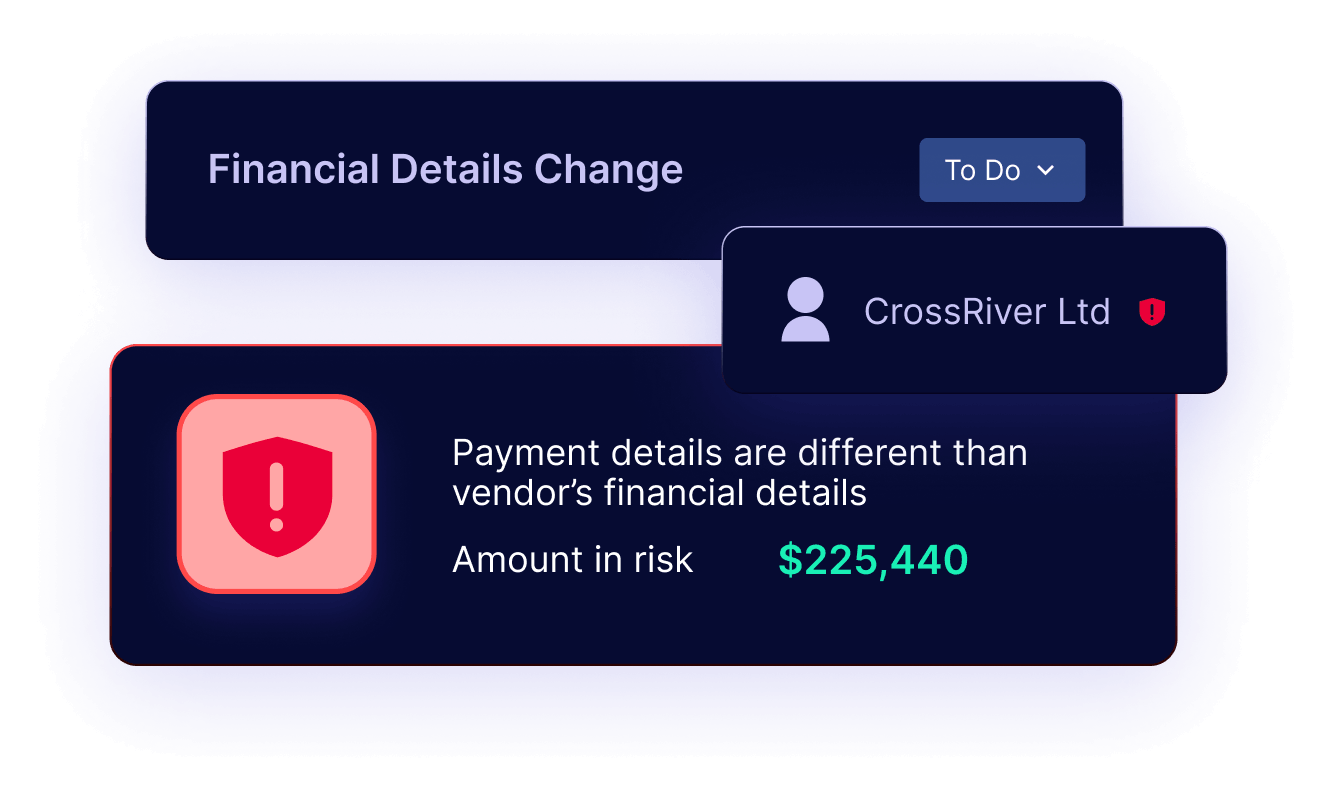
The File Analysis Engine goes after the file itself: metadata and creation history, AI-driven visual tampering detection, and a comparison against documents that vendor sent before. Then it looks at what the document is asking for, so a bank change tucked into routine paperwork gets checked against the vendor record instead of approved along with it.
Put those signals together across email, ERP, and vendor records, and the anomaly no single system can see shows up, with the payment held for review before funds leave.
Trusted by Finance and Security Leaders






“Trustmi provided transparency into our payment process to see where cyberattacks and errors were happening and full protection without changing our workflow."

“Like many businesses today, we’ve experienced cyber attacks on our payment process, but we didn’t realize the extent to which we were at risk until we evaluated Trustmi. Now we’re confident we’ll be able to avoid future attacks with their platform.”

“Trustmi’s platform is an important tool for our team. Their Payment Flows module increases our payment cycle security, and our team has also managed to cut down the time for preparing payments reports from half a day to half an hour.”

“Trustmi provided transparency into our payment process to see where cyberattacks and errors were happening and full protection without changing our workflow."
“Like many businesses today, we’ve experienced cyber attacks on our payment process, but we didn’t realize the extent to which we were at risk until we evaluated Trustmi. Now we’re confident we’ll be able to avoid future attacks with their platform.”
“Trustmi’s platform is an important tool for our team. Their Payment Flows module increases our payment cycle security, and our team has also managed to cut down the time for preparing payments reports from half a day to half an hour.”
$240 Billion Secured
Protecting businesses globally against socially engineered fraud and errors.
Up to 2.5% of Budget Saved
By Eliminating Fraud and Payment Errors
From Hours to Seconds
Manual Process Time Reduced
 Behavioral AI-powered security
  Protection on day one
  10-15x ROI