




You are right to put AI to work in accounts payable. Just be careful what you point it at.
Most AI in payments today is pointed at one thing: doing the old process faster. Faster capture, faster coding, higher touchless rates, fewer hands on each invoice. That sounds like progress, and some of it is.
But speed only helps if what you’re speeding up is sound. Pour AI onto a business payment process that already has gaps, and you don’t close those gaps. You run them faster. The mistakes still get made, the bad payments still go out, they just go out quicker, and with less time for anyone to notice.
So as finance shops for AI products, the real question isn’t just how much faster AI can make you. It’s also whether your AI is speeding things up and fixing the gaps in the process.

The Risk in AI in Payments Isn’t Speed, It’s Context
The risk is what AI doesn’t see. AI that only scores the payment in front of it can miss the signals that appear across history and across systems: a duplicate of an invoice already paid, a bank account changed last week, or a series of transfers that only form a pattern when you line them up. Each can look fine on its own. The problem lives in the connections.
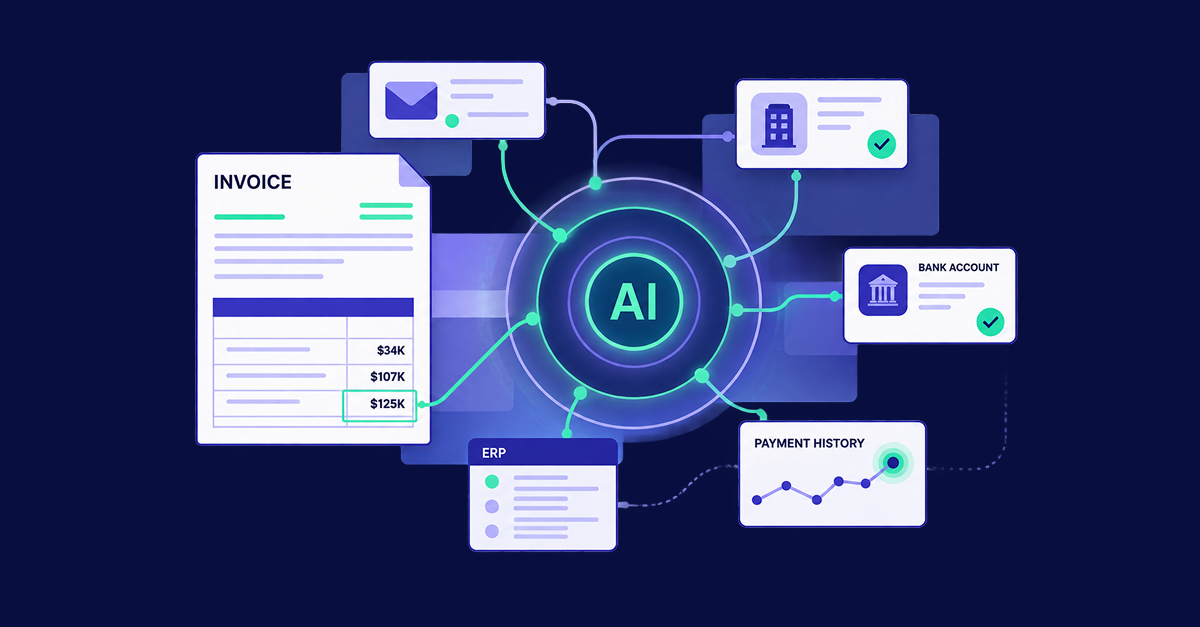
Often, this is architectural. Much of the AI in payments today is bolted onto tools built to process invoices, not to connect the invoice to the email, vendor record, bank change, and payment history around it. So the AI is only as wide as the system it sits in. The signals exist—they just never come together.
That matters because modern payment fraud is designed to look legitimate at each individual checkpoint. In Trustmi’s 2025 report on how finance-security misalignment fuels loss, most attacks moved across more than one system, so no single control saw the whole thing. And in the 2026 Payment Security & Risk Benchmark, more than 90% of attacks used bank accounts that passed standard validation. Spread across systems and legitimate at every checkpoint, a bad payment can look perfectly good in isolation.
Modern fraud isn’t built to break your controls. It’s built to satisfy them. Here’s how that actually plays out, and it’s why AI needs to see more than the payment in front of it.
Good AI in Finance Reads Across Time and Systems
The better use of AI in finance is not slower. It is wider, in two directions.
- Across time. Good AI weighs each payment against the history around it: is this invoice a near-duplicate of one already paid? Does this vendor usually bill this way? Fraud is rarely isolated to a single invoice or payment, and neither are everyday errors, so the pattern only shows when you look back.
- Across systems. Good AI reads each invoice against the email that carried it, the vendor record behind it, the bank change that preceded it, and the timing of the request. A suspicious payment is rarely just an invoice problem. The evidence is scattered across AP, vendor, banking, email, and identity, and when those signals stay in separate tools, detection sees only fragments instead of the full picture.
This is not theoretical. In one case documented by McKinsey, a global biotech company used AI to check invoices against contract terms across the whole year, and caught leakage worth roughly 4 percent of total spend, issues that only surfaced when cumulative invoices were viewed together, not one at a time.
That is the advantage of context. The more of the payment process AI can see, and the further back it can look, the better chance it has of catching what looks perfectly normal in isolation. Seeing across time and systems is exactly what an AI trust layer does, and it’s the difference between catching the pattern and clearing it.
Questions To Separate Good AI From Fast AI
If fast alone isn’t the goal, what is? A few questions separate AI that just moves quickly from AI that actually helps, and they are less about speed than about sight:
- Does it score each payment against its history and the vendor’s past behavior, or only the transaction in front of it? (Context across time.)
- Does it read across email, invoice, vendor records, and banking, or only the invoice itself? (Context across systems.)
- Does it tell you what it caught and what that was worth in dollars, or only how much faster it made you? (Value you can measure.)
An AI that only answers the speed question will make you faster at approving whatever comes through. An AI that answers the others will catch what speed alone lets past.
What You Actually Want: Fast, Contextual AI
This is not a choice between fast and careful. What you want is fast, contextual AI: the kind that reads each payment across time and across systems, not in isolation, and still moves at speed. You do not trade throughput for judgment. You get both.
So measure how much faster AI makes you. That gain is real. But measure what it catches, too: the duplicate payment that never goes out, the fraudulent bank change that never becomes a transfer, the invoice that looks normal until it’s compared with everything around it.
Speed is one kind of ROI. The money you never lose is another.
To see where that value shows up across the invoice-to-pay process, and how to build the ROI case for it, read our whitepaper with IOFM: AI in Accounts Payable: Where to Invest and How to Prove the ROI to Leadership.



 Behavioral AI-powered security
  Protection on day one
  10-15x ROI