




Boards have made the call: AI is coming to finance, and the CFO has to lead it. What nobody hands over is the part that matters most, where to begin. The market is loud with options and quiet on priorities, and the CFO is left to guess which one earns its budget first while being accountable for every dollar that leaves the door.
And the guessing isn’t going well. Boards expect AI to pay off, but only 14% of finance leaders see real ROI today. That’s not because AI doesn’t work. It’s that most teams start where the returns are real but hard to prove. “Faster forecasting” and “better insights” are genuine, but you can’t put a number on them for a board. So the work happens, the value stays fuzzy, and the ROI conversation stalls.
There’s a better place to start. Start where the money moves.

Where to Start With AI in Finance: Why Payments Wins
The case for payments comes down to one word: countable.
When AI catches a duplicate invoice, flags a fraudulent vendor change, or stops a payment that shouldn’t go out, the result is a dollar figure, money that would have left and didn’t. That’s the one AI outcome a CFO can take to the board without a caveat, and it’s the one most finance-AI projects can’t produce.
McKinsey found that AI identified roughly 4% of contract leakage on total spend at a $1B company. In a year, stopping that leak is about $40M in recurring margin. That value doesn’t live in a dashboard. It lives in the spend-and-payments layer, where real money is moving and small errors compound quietly at scale.
And payments is where exposure concentrates. Start where the biggest, most measurable losses happen and the return shows up fastest, verification pays for itself the first time it catches something.
That’s what sets payments apart. It’s not just a high-value use case, it’s the one where you can prove the value. Which flips the 14% problem: most finance leaders can’t show AI ROI not because the tech fails, but because they started somewhere the returns couldn’t be counted.
Faster Money, Less Time to Catch It
This isn’t only great ROI, but it’s also business critical. AI can move money faster than legacy controls can verify it. As finance automates approvals and drops manual review to keep up, the window to catch a bad payment shrinks toward zero, and finance is still accountable when one’s wrong.
And the controls companies already trust aren’t holding. In Trustmi’s 2026 Payment Security & Risk Benchmark Report, more than 90% of analyzed attacks used bank accounts that passed standard validation. Fraud isn’t breaking those controls, it’s passing them. And it isn’t only fraud, duplicate payments and simple errors slip through the same gaps, quietly and at scale.
That’s why payments is the place to start, not despite the stakes but because of them. AI without verification doesn’t cut risk, it scales the errors and fraud your controls already miss, just faster. AI with verification puts the safeguard where exposure is highest. That’s the difference between AI that adds risk and AI that removes it.
What “Start With Payments” Looks Like in Practice
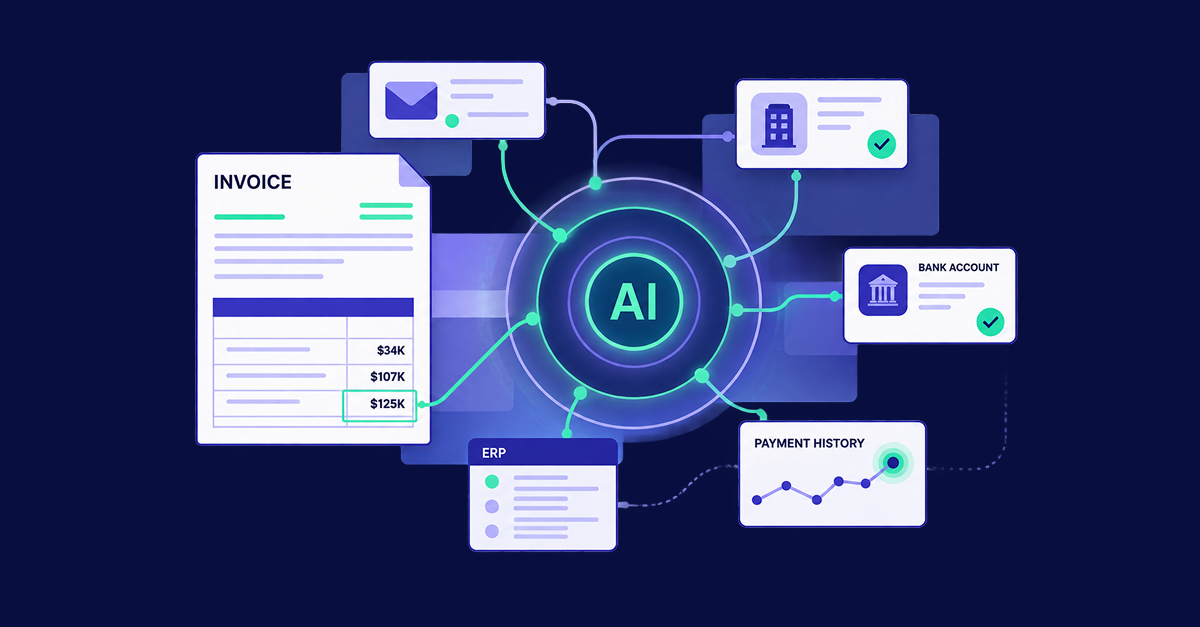
Starting with payments means putting an AI trust layer at the moment a payment, vendor, or account change goes through, so the check happens before money moves, not in a report afterward.
In practice, the questions a sharp finance team would ask on its best day get asked on every transaction, automatically:
- Is this the vendor’s real account, or one changed last week?
- Does this invoice match the order, or duplicate one already paid?
- Does this urgent request from the “CFO” sound like how they actually talk?
A person catches these when they have time and context. At machine speed, across thousands of payments, they can’t. That’s the whole point: AI that checks the things people no longer have time to check, and produces a number the board can see, a duplicate invoice caught, a fraudulent change stopped. See how that works across the payment process →
Where to Go From Here
Every AI initiative in finance eventually moves money. Starting with the layer that verifies those movements gives the CFO what the rest of the roadmap can’t: a return they can measure, a risk they’ve cut, and proof the board can see.
And it’s not theoretical. Across the payments Trustmi has validated, organizations recover up to 2.5% of budget by killing fraud and payment errors, averaging $1.5M in detected and prevented losses, returns in the 10-15x range.
The pressure to adopt AI is not going away. The question of where to start has a clear answer: where the money moves, and let the ROI prove itself.




 Behavioral AI-powered security
  Protection on day one
  10-15x ROI