




Almost every tool a finance team looks at now has “AI” stamped on it. And lately, the label of choice is “AI agent.” Old products, new products, features that shipped last year, they all suddenly have agents.
That leaves finance leaders in a strange spot. They’re being sold something called an agent in nearly every demo, but the label doesn’t say much about what the product actually does. The word has outrun the meaning.
AI belongs in finance, and it can do real work. But before enterprises put it to work on anything that matters, they need to know what they’re actually buying. So here’s a plain-language way to tell the difference. No jargon, no architecture lecture.

AI Agent vs. Copilot: The Simplest Way to Tell Them Apart
So, what is an AI agent, and how is it different from a copilot?
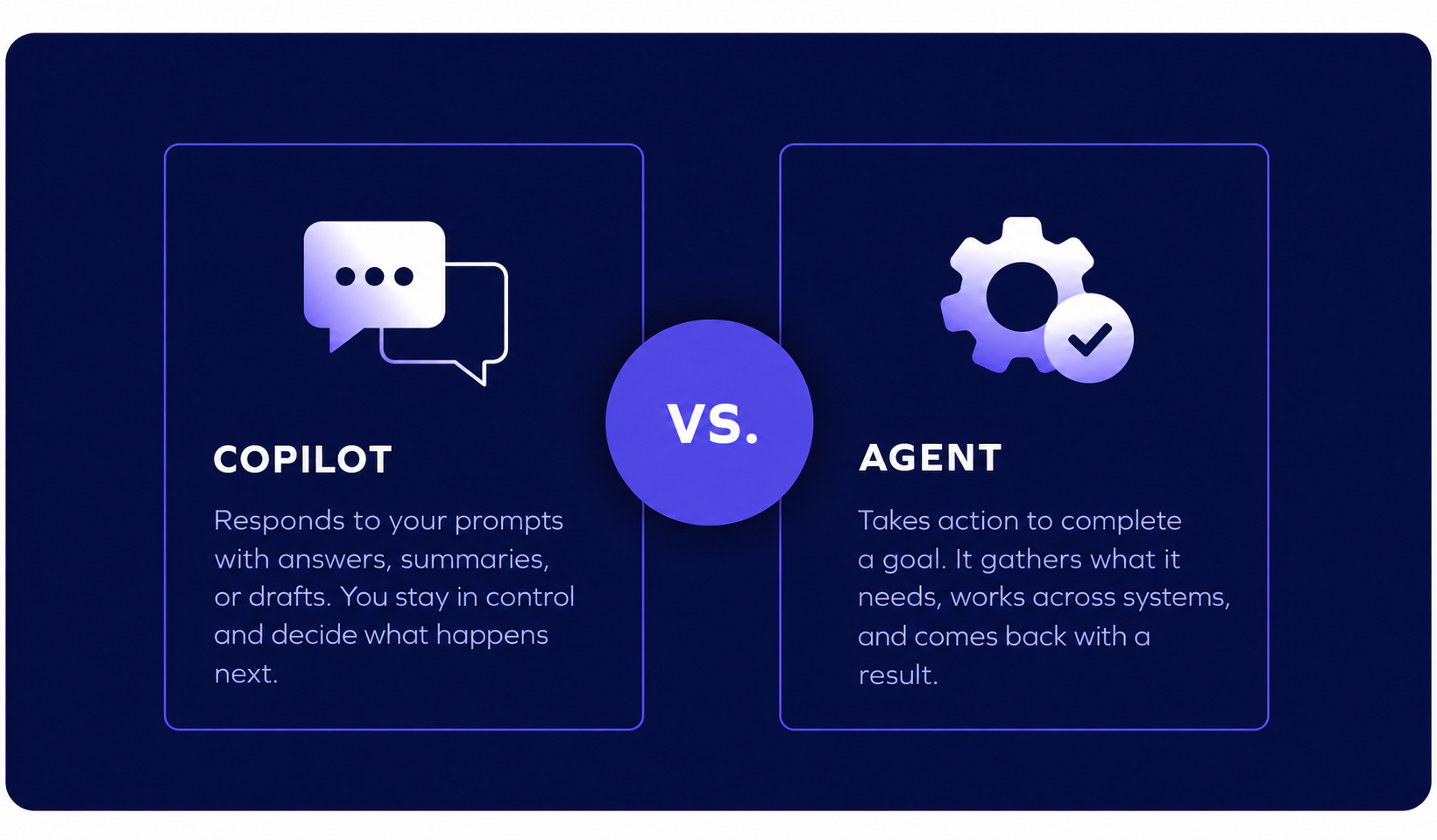
A copilot is an assistant that responds. Give it a question or task, and it answers, summarizes, or drafts. It is quick and genuinely useful, but it waits for a prompt.
An agent is a worker that acts. Give it a goal, and it carries out the steps on its own, gathers what it needs, and comes back with a result. Instead of feeding it one instruction at a time, the team hands it the job.
In one line: a copilot helps teams do the work. An agent does the work and shows them what it found.
The technical definitions can vary, and the line between the two isn’t always clean. But for finance teams evaluating AI, the more useful distinction is what the tool actually does.
Why the Difference Is Easy to Miss
The two genuinely blur. A capable copilot can feel agentic, and plenty of tools use the terms interchangeably. So the label on its own won’t tell finance teams much.
Three plain questions cut through it:
- Does it wait for a prompt, or run on its own once given a goal?
- Does it summarize what’s handed to it, or go get information and connect it?
- Does it hand the team a to-do, or come back with a result?
None of these questions require an understanding of how the technology is built. They describe what it actually does.
What This Looks Like in a Real Payment Investigation
The difference stops being abstract the moment the same task runs through both. Take one every finance team knows: a payment that’s about to be approved but doesn’t look quite right.
Maybe a vendor the company has paid for years is suddenly asking for funds to be sent to a new account. Maybe an invoice is a little off, or the timing of the request feels wrong. The finance team can’t approve it until they’re sure it’s legitimate.
The information needed to figure that out probably exists. The problem is that it doesn’t exist in one place, or with one team. Finance has the business context. Security may have the email and technical signals. Vendor and payment records live somewhere else.
That’s why these investigations get slow. Someone has to bring those systems and teams together before the payment can move.
This is the kind of investigation Trustmi’s AI Investigation Agent was built to handle. So rather than keep the comparison hypothetical, here’s what this same investigation looks like as a copilot task versus an agent task.
Two Ways to Investigate the Same Payment
As a copilot. The finance team gathers the records itself: the email, invoice, vendor history, and payment data. The copilot reads them, points out what looks inconsistent, and helps the team make sense of it.
- What’s good: When the pieces are already in front of the team, it’s fast and useful.
- The catch: The team still has to find and gather those pieces. If more context is needed from security or another team, someone still has to go get it.
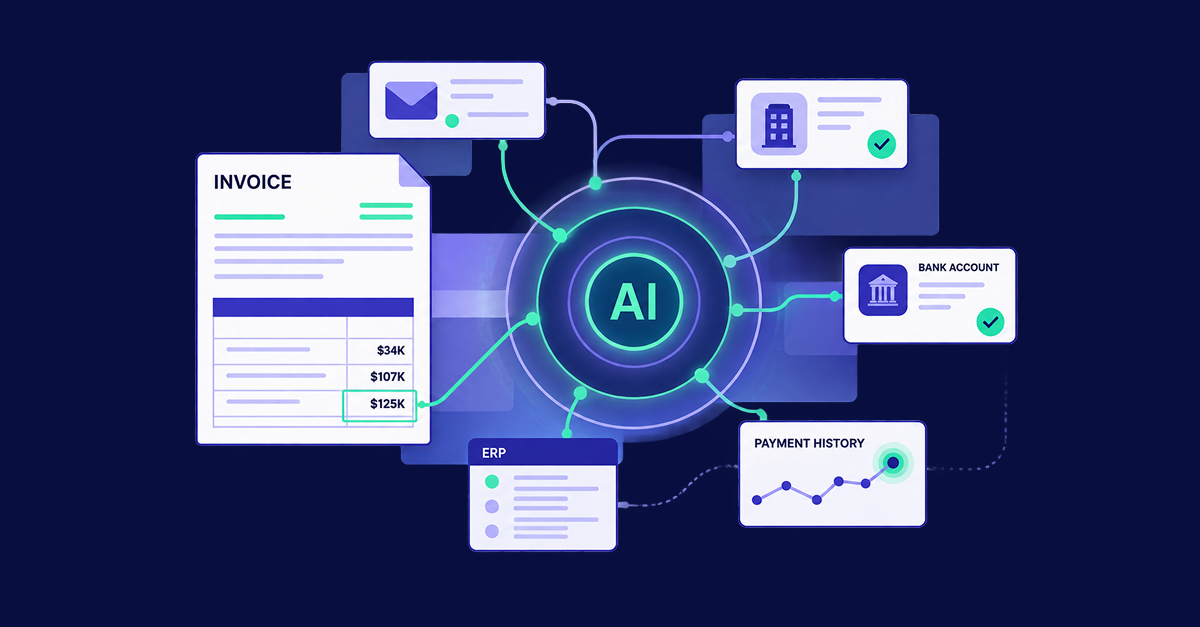
As an agent. Trustmi’s AI Investigation Agent checks the email, invoice, vendor record, and payment history, connects the evidence across those systems, and brings in the right people when more context is needed.
- What’s good: Finance and security can work from the same evidence and investigation instead of piecing together separate findings.
- The catch: An agent doing this work has to show its work. Teams need to see the evidence behind the result, not simply trust an answer.
That’s the real distinction. A copilot can help a finance team understand the information put in front of it. An agent can go find the information, connect it, do the work, and show how it reached the result.
And in an enterprise, the work doesn’t only cross systems. It crosses teams. A payment investigation may need finance’s knowledge of the vendor, security’s view of the email activity, and information sitting inside financial systems. A useful agent can connect the people who understand those signals around the same investigation, not just connect the data they each hold.
Here’s what that looks like in the AI Investigation Agent:
What to Ask Before You Buy AI for Finance
None of this makes copilots bad. A good copilot is genuinely useful, and plenty of finance work is well served by one. The point isn’t that one is always better. It’s that they do different jobs, and the difference matters most when an organization is buying AI to do real work rather than answer a question.
So when a vendor says its product has an agent, finance teams don’t need to spend the demo debating the definition. A few practical questions reveal much more.
What does it actually do on its own?
Ask what happens after the agent is given a goal. What does it gather and carry out itself, and where does it hand control back to a person? If the team still has to direct every step and gather the information, people are still doing a meaningful part of the work.
What does it need access to in order to do the job?
An agent that can only work with manually uploaded information may not remove much work. Enterprises should understand what systems and information it needs, where that information comes from, and what the agent can and cannot do with it.
Can it show how it reached the result?
In finance, “the AI said so” isn’t enough. Teams need to see the evidence, understand what drove the result, and know when a person needs to step in.
Can it bring the right people into the work?
Finance tasks often cross AP, treasury, procurement, security, or IT. A useful enterprise agent shouldn’t create another silo. It should make it easier for the right teams to work from the same information and contribute their expertise when it’s needed.
Can the vendor put a number on the value?
What does the agent reduce: cost, cycle time, manual reviews, exceptions, or losses? How much human work does it actually remove, and what does the AI itself cost to run? If neither the value nor the cost can be measured, it’s difficult to know whether the organization is buying productivity or another layer of technology.
That’s ultimately the test for AI agents in finance. Does it actually do the job, or just talk about it? Can it show how it got there? And does it make the people involved in that work more connected, or give them one more tool to manage?
Finance leaders don’t need to know how every part of the technology is built. They need to know what changes when the technology is put to work.
Ready to put a number on AI in finance? Get our guide with IOFM, AI in Accounts Payable: Where to Invest and How to Prove the ROI



 Behavioral AI-powered security
  Protection on day one
  10-15x ROI