




Three-way matching is one of the most established controls for preventing payment errors in accounts payable (AP). And at enterprise scale, those errors carry significant financial risk. According to APQC benchmarking data, 5% of payments at the median-performing organizations are not error-free the first time.
By comparing purchase orders, receiving records, and vendor invoices before payment approval, three-way matching helps AP teams catch discrepancies before they become costly mistakes.
But how effective is it? Three-way matching catches many common payment errors, yet a successful match does not guarantee an accurate payment. The distinction comes down to what the control actually verifies, and what falls outside its scope.
How Three-Way Matching Works in Accounts Payable
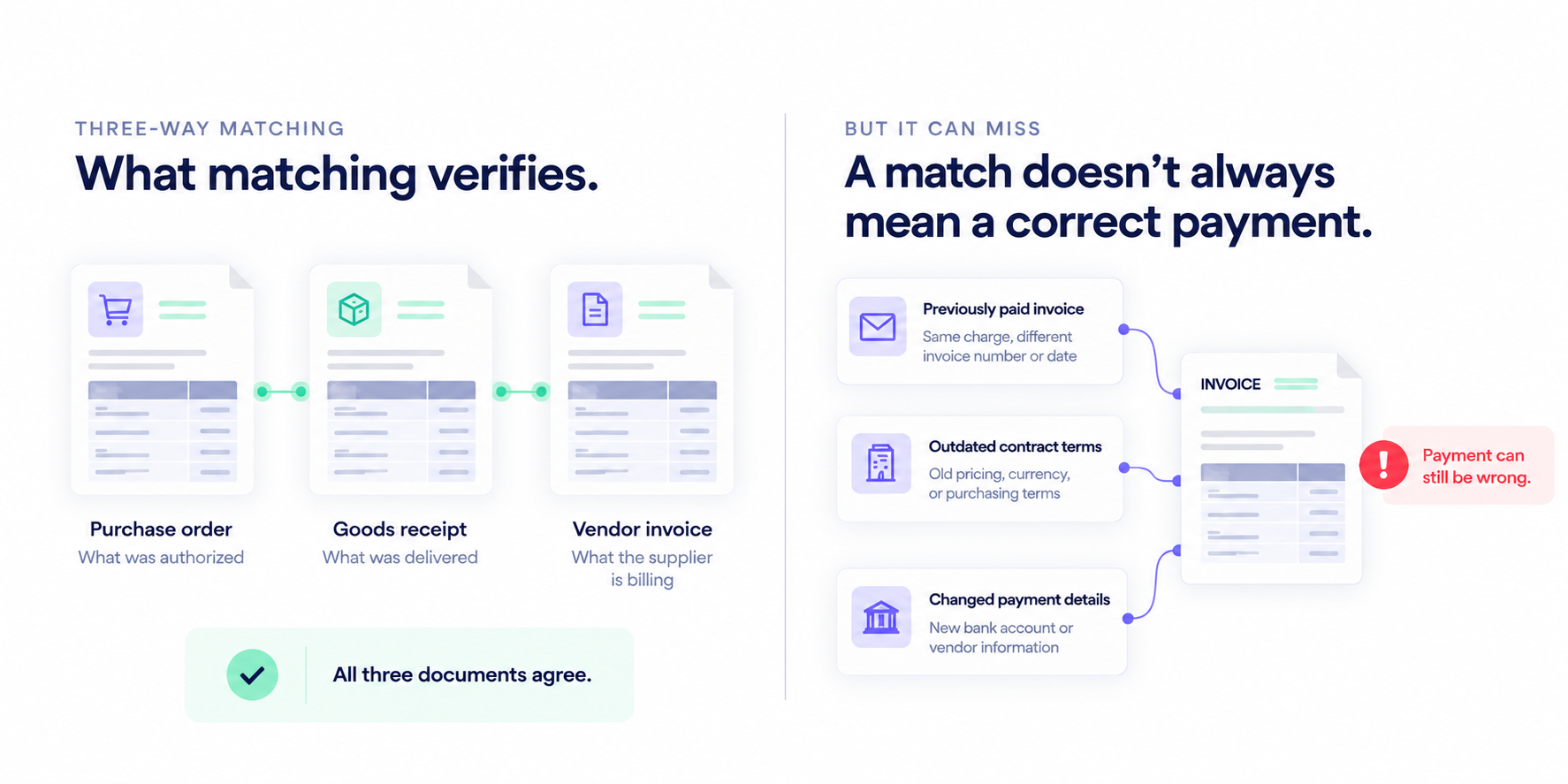
To understand what three-way matching can and can’t catch, it helps to start with what the process actually verifies. Three-way matching compares three documents, each serving a distinct purpose:
- Purchase order (PO): What was authorized, including the supplier, quantities, and agreed prices.
- Goods receipt: What was delivered or, where applicable, which services were performed.
- Vendor invoice: What the supplier is billing the organization for.
The difference between two-way, three-way, and four-way matching comes down to which records are checked. Two-way matching compares only the purchase order and invoice. Adding the receiving record creates a three-way match, while four-way matching goes a step further by including an inspection or quality acceptance record.
With three-way matching, when the three align within configured tolerances, the invoice can proceed through approval. When they do not, an exception is raised for AP to investigate before payment. For example, if a PO authorizes 100 units at $50 each but the receiving record confirms only 90 arrived, an invoice for all 100 triggers a quantity discrepancy. The team can investigate the discrepancy, correct any receiving-record error, request a revised invoice, or hold payment until the remaining goods arrive.
What Payment Errors Does Three-Way Matching Prevent?
Three-way matching is a standard AP control for good reason. It catches discrepancies that might otherwise result in incorrect payments.
- Quantity mismatches: Suppliers billing for more units than were ordered or received.
- Pricing discrepancies: Invoice prices that differ from the purchase order.
- Goods not received: Invoices without the required delivery confirmation.
- Unsupported charges: Additional line items or amounts without corresponding support in the PO or receiving record.
These checks help prevent payment for goods not received or charges that do not align with the underlying purchase. They also reduce the cost and effort of investigating discrepancies after payment, when recovering funds can be considerably more difficult.
But matching only catches errors that create discrepancies between documents. What happens when all three documents agree, and the payment is still wrong?
Where Three-Way Matching Falls Short
The gaps become apparent when the records agree on incorrect information, or when the information needed to recognize a problem sits outside the match.
1. Incorrect Information Can Still Produce a Perfect Match
Three-way matching assumes the purchase order is an accurate reference point. But an outdated contract price, incorrect currency, or purchasing terms that no longer reflect the supplier agreement can carry through to the invoice. If the invoice repeats the same mistake, the documents match without triggering an exception.
This matters for enterprises managing thousands of suppliers, negotiated pricing arrangements, and purchasing activity across multiple business units. Contract terms change, but updates do not always reach every system or purchasing team at the same time. The match has confirmed the paperwork is consistent. It has not confirmed the organization is paying what it actually agreed to pay.
2. Tolerance Thresholds Can Let Small Errors Through
Tolerance thresholds allow organizations to accept minor discrepancies without sending every invoice for manual review. They are essential for keeping high-volume AP operations efficient, but they can also allow small overcharges to proceed without additional scrutiny.
Consider a supplier whose invoices consistently fall just inside the accepted variance. Depending on how tolerances and cumulative checks are configured, individually accepted discrepancies can add up to significant costs across thousands of transactions.
The question is not whether tolerances should exist. It’s whether anyone is looking at the patterns of discrepancies being accepted over time.
3. Some Errors Exist Outside the Three Documents
Three-way matching evaluates the purchase order, receiving record, and invoice, but the information needed to identify a payment error does not always sit within those documents.
Payment history across systems is one example. An invoice may match its PO and receiving record even when the same charge has already been paid. Separate duplicate-detection controls are designed to catch these errors, but their effectiveness depends on access to relevant invoice and payment history. For enterprises operating across multiple ERPs, entities, and payment systems, that history may be fragmented. A transaction can satisfy every matching requirement in one system without being evaluated against payments made elsewhere.
The limitation extends beyond payment errors to fraud. An invoice from a legitimate supplier can match a valid PO and confirmed delivery even when an attacker has manipulated the vendor’s payment instructions. The documents are accurate, but the payment may still be fraudulent because three-way matching was never designed to establish whether the payment destination is legitimate.
These limitations raise an important question: If three-way matching can’t catch every error, how much of that gap can automation actually close?
What Three-Way Matching Automation Can and Can’t Do
Automation can surely make three-way matching faster and easier to scale. AP systems compare documents, apply rules, and route exceptions without manual review of every invoice. AI- assisted tools can extract invoice data and reconcile more complex transactions, reducing exception-handling work.
But faster invoice matching is not the same as broader payment verification. If the systems or controls are flawed to begin with, AI will only make fraud and errors faster. This is where Behavioral AI serves a different purpose. It can connect information across invoices, vendors, approvals, and payment activity to identify discrepancies and unusual patterns that are not visible within the three matching documents. Instead of assessing an invoice only against its own paperwork, it considers the broader context of the payment.
The goal is not to replace three-way matching or give AP teams more exceptions to manage. It is to extend visibility beyond the match.
A Perfect Match Is Only Part of the Picture
Three-way matching remains an essential control for preventing payment errors. But as enterprise payment operations grow more complex, accuracy depends on more than whether three documents agree. It also depends on information that matching alone cannot evaluate.
The answer is not abandoning a control that works. It is giving it the context it does not have.
Trustmi’s behavioral AI payment security platform connects information across vendors, invoices, approvals, and payment activity to identify costly errors and fraud that individual systems may miss. AI agents investigate flagged activity and assemble relevant evidence, helping AP teams make informed decisions before money moves.
Learn how Trustmi helps enterprises catch payment errors before money moves.



 Behavioral AI-powered security
 Protection on day one
 10-15x ROI
